 |
 |
 |
 |
Sea Floor Spread The Earth's longest mountain chain isn't the Andes in South America, or the Himalayas in Asia, or even North America's Rockies. It's an underwater chain of mountains 47,000 miles long. The chain runs down the middle of the Atlantic Ocean (surfacing at Iceland), around Africa, through the Indian Ocean, between Australia and Antarctica, and north through the Pacific Ocean. Running along the top of this chain of mountains is a deep crack, called a rift valley. It is here that new ocean floor is continuously created.
Convergent Boundary New crust is continually being pushed away from divergent boundaries (where sea-floor spreading occurs), increasing Earth's surface. But the Earth isn't getting any bigger. What happens, then, to keep the Earth the same size? The answer is subduction.
At a depth between 190 and 430 miles (300 and 700 kilometers), the rock of the descending plate melts. Some of this molten ocean floor makes its way to Earth's surface, producing volcanoes. Most of it, though, becomes part of the Earth's mantle, perhaps to reappear much later at a distant divergent boundary.
|
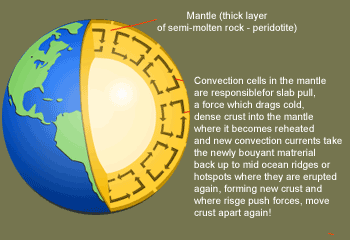 The theory of continental drift was first proposed in 1912 by Alfred Wegener, his ideas wern't really accepted until the early 1960s. This theory, is known as plate tectonics. Below are some examples of what happens at different points on the earth's crust as plates collide and move apart, albeit at a very slow pace!
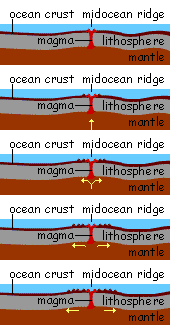 The speed at which new ocean floor is created varies from one location on the ocean ridge to another. Between North America and Europe, the rate is about 2.2 inches (3.6 cm) per year. At the East Pacific rise, which is pushing a plate into the west coast of South America, the rate is 12.6 inches (32.2 cm) per year.
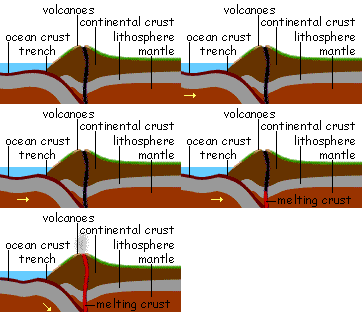 In locations around the world, ocean crust subducts, or slides under, other pieces of Earth's crust. The boundary where the two plates meet is called a convergent boundary. Deep trenches appear at these boundaries, caused by the oceanic plate bending downward into the Earth.